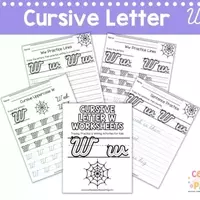
These specialized materials are designed to facilitate children’s acquisition of cursive writing skills, specifically focusing on the letter ‘U’. Comprising nine distinct pages, these printables offer a step-by-step methodology for learning both the capital and small forms of the letter, as well as integrating them into words and full sentences. The structured approach not only makes learning enjoyable but also effectively bolsters a child’s confidence in their penmanship abilities. These resources are versatile, suitable for diverse educational settings including traditional classrooms, home-schooling environments, or as supplementary practice at home. Furthermore, the ready-to-use format simplifies the integration of handwriting drills into daily routines for both educators and parents.
Details of the Cursive Letter 'U' Worksheets Program
The comprehensive set of worksheets, developed by expert Michele Tripple, a life coach and family studies specialist, is meticulously crafted to improve fine motor skills and enhance writing fluidity in children from second to fifth grade. Each worksheet provides varied exercises, from direct tracing of the letter ‘U’ in both its uppercase and lowercase forms to advanced practice with connecting strokes and full sentences. Specific examples of words children will encounter include “Up,” “Us,” “Uniform,” “Umbrella,” and “Uncle.” The program emphasizes consistency and control, crucial elements for effective cursive writing. These materials can be downloaded for free upon email registration or purchased for immediate access, making them convenient for parents and teachers. The developer also suggests breaking down the learning process into short, manageable sessions, ideally 5-10 minutes each, to prevent overwhelming the child. Celebrating small achievements during this journey is encouraged to maintain motivation. Creative methods to keep children engaged include using colorful writing tools, setting timed challenges, and offering small rewards. This strategy ensures that learning cursive remains an engaging and fulfilling experience rather than a chore.
The practice of cursive writing, often considered a traditional skill, continues to be highly relevant in modern education. Beyond its primary function, it significantly contributes to the development of fine motor skills, improves memory retention, boosts reading fluency, and builds overall confidence in written communication. In an increasingly digital world, cursive writing also offers a valuable “screen-free” activity, promoting focused engagement away from electronic devices. This holistic approach ensures that children not only learn to write beautifully but also develop essential cognitive and physical skills that benefit their broader academic and personal growth.